Choose Your Life or It Chooses You
2026-06-23
Thanks to Isaia Gisler for valuable feedback on this post.
In about two years at ETHZ I switched degree twice. I started in electrical engineering, moved to physics, then to maths, and these days I'm veering towards theoretical computer science. Each switch cost at most a few months of catching up and was worth it every time, because each one got me a little closer to what I actually wanted to do. I realise taking path-choosing advice from someone who's switched three times is a little suspicious, but that's exactly why I think I have something useful to say about it.
 Caspar David Friedrich, Wanderer above the Sea of Fog (1818).
This advice is for incoming maths and physics students at ETHZ, and I gave a short version of it as a talk at the pre-study events. I've tried to keep the administrative stuff to a minimum, you'll get plenty of that elsewhere. It's mostly what I wish someone had told me when I was starting out.
Before anything else, one honest disclaimer. I have not figured life out, no one truly has. We are all still working it out. Our beliefs get shaped mostly by what we live through, more than by clever arguments. Think about how rarely you have genuinely changed someone's mind in a debate, or had yours changed by one. So the most useful thing I can do is tell you honestly what worked for me and why, then encourage you to go and have your own experiences: read some philosophy, join clubs, meet as many people as you can, and draw your own conclusions.
So here is the one idea I most want to leave you with, and everything below hangs off it. You have a rare few years where changing direction is almost free. Choose your life before it chooses you.
The practical bits, housing, tools etc. are all at the bottom. Start there if that's what's keeping you up at night.
Figure out what you actually want
If one does not know to which port one is sailing, no wind is favourable.
- Seneca
Before your degree even starts is a good time to ask what you actually want out of life, and what you value most. I didn't really do this. I was so caught up in the logistics of moving country and starting university that I never stepped back to think about where I wanted to end up, and that is part of how I rushed into electrical engineering. It's fine to work this out as you go, but the sooner the better.
Writing is the best way I know to organise and process these thoughts instead of letting them swirl, and it's a habit I'd strongly recommend picking up. Making a website is great motivation to polish your ideas and put them out into the world, where they can do some good. Good thoughts that stay in your head are wasted.
It's also worth keeping a record of your experiences. As AI makes raw reasoning cheap and abundant, the things you have actually lived through might turn out to be the scarcest and most valuable thing you own, so capture them while they're fresh.
It's fun to spend some time reading about the people behind ideas, like Turing or Gödel, or whoever you keep running into. The historical development of these fields is genuinely interesting in its own right, not just the polished end results you get taught. It also makes the whole thing feel more human, there were real people and fascinating stories behind these discoveries.
Don't be in a rush to start working. It's striking how much a place like university accelerates ones personal development, certainly more than most jobs would. The working part of life comes around soon enough. Use these years for the development they're actually for, and stay in them as long as you reasonably can.
I'd also push back on the plan I hear often, which is to get rich quickly, retire as early as possible, and then have fun, or do some good, forever. It tends to disappoint at both ends. The years you would grind away at something you resent are your best ones, with the most energy and the fewest obligations, and you don't get them back. Fun fades the more of it you have, while the thing that stays most satisfying in my opinion is making a real difference to the world.
The retirement half rarely arrives either. What usually happens is that a family, a mortgage and a whole set of obligations turn up first, and the plan never comes to life. Anything ambitious needs your full attention at exactly the age you'd have spent on the detour. So I'd work out what you want to build first and worry about paying for it second, since there is far more money out there for a good idea, in grants and in venture funding, than most students assume. And money is only a proxy for doing something valuable, so like any proxy it stops measuring what it measured the moment you optimise for it directly. Go into finance by all means if the problems themselves grip you, plenty of them are genuinely interesting, just be honest with yourself about whether it's the work pulling you in or the salary and the glamour around it.
Your studies aren't yet a job that demands strict observance of its schedules. Some people treat them like one to stay disciplined, which is fair enough, but I think its good to allow yourself to pursue your obsessions as they come sometimes. Too much discipline can do you real harm and exclude you from pivotal experiences.
All of this matters because genuine interest is what carries you through the hard parts. You'll pour something like 80,000 hours into a career (also the name of an Effective Altruism aligned organisation and popular podcast) and every path has stretches that are boring and grueling, the kind you can only get through if you actually love the thing. As Paul Graham puts it, interest will drive you to work harder than mere diligence ever could.
One framework I like here is ikigai:
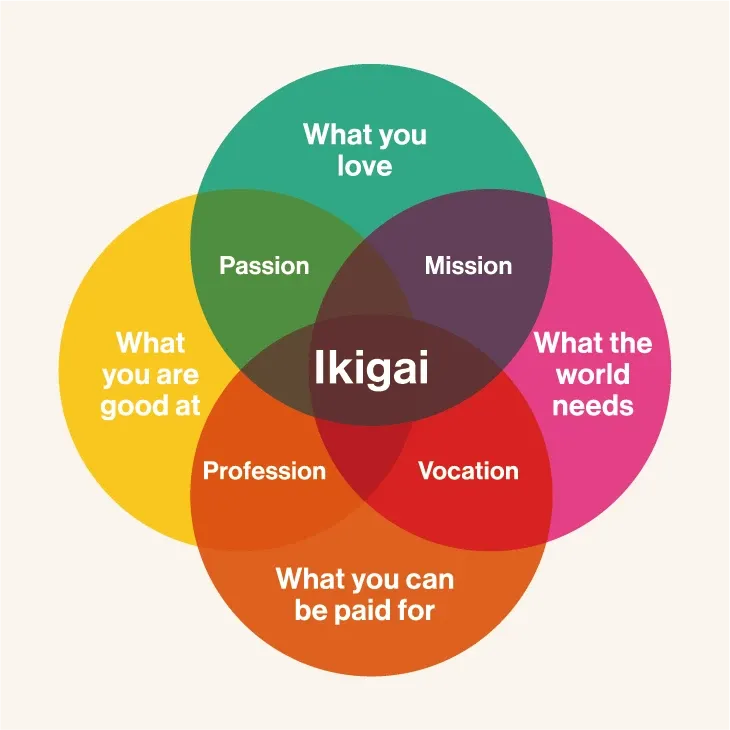
One reliable way to discover what you genuinely love is to ask what you'd spend your time on if you never had to earn a living. Many of those answers can be bent towards something society values, and if the only things that come to mind are purely for fun / consumption rather than making anything, don't take that as a verdict on yourself. It usually just means you haven't yet found the thing that would grip you. Most of what I care about now I hadn't even heard of at eighteen, so if nothing really pulls at you yet, finding out what's out there should be your first priority.
Whatever you land on, keep checking it. It's easy to get deep into something and only realise much later that you've been heading the wrong way for a long time. Take a step back now and then and ask whether what you do every day is really moving you towards what you want. Knowing when to change direction is a skill that comes with time too.
It's also worth staying grateful. You're using these years to develop yourself as a person, and here that is heavily subsidised by Swiss taxpayers, with the aim of cultivating people who go on to better society. Everyone has their own struggles, whether financial, health related, or something else. It's worth acknowledging that and doing your best while you're able to.
If you want to read further, PG's essay What You'll Wish You'd Known and Terence Tao's career advice are both worth your time.
Get out and meet people
Tell me with whom you spend your time, and I will tell you who you are.
- Goethe
The people are one of the best things about university, and it's easy to underrate this when you're buried in exams. You'll probably never again be surrounded by this many curious, like-minded people your own age, with labs, libraries and sports facilities all on tap, so make the most of it.
 Raphael, The School of Athens (c. 1510).
That starts with not putting your life on pause for exams. There are exams and they matter, but you can't study at full intensity all day, and sitting in the library daydreaming isn't studying. Do whatever you're doing at full focus, and you'll free up a surprising amount of real time. Use it for the things that might actually shape your direction: side projects, a rabbit hole outside your curriculum, meeting people. The sooner you start having these experiences the better, and one heuristic I like is to live as if you only had five years left. Paul Graham's Life is Short is worth reading on this.
A lot of those path-changing experiences come from other people. Plenty of them have wrestled with the same questions you're sitting on, and a single conversation can save you months. So keep meeting people, and say yes to the odd thing you'd normally talk yourself out of.
It helps to drop the social rules you picked up at school. In the first week, groups form for completely arbitrary reasons, and it's tempting to lock into the first one you land in. Keep mingling well past the pre-study events, and talk to people outside your own degree. The people you meet in your first few weeks won't necessarily be your closest friends later, they certainly weren't for me. If some friends from school are coming to ETHZ too, don't just stick with the familiar faces. Keep a few long friendships alive by all means, but don't let them stop you exploring. The people you spend time with shape who you become, so choose them deliberately, and question your assumptions about who you'll get on with.
Being approachable is itself a skill. I stopped wearing headphones in public spaces for this reason, the library is the place for quiet focus. It also helps to wear what you care about somehow, a laptop sticker or a custom t-shirt, once you have a rough idea of what you're into. It gives people an easy excuse to start a conversation with you. It's okay to embarrass yourself a little for the sake of some human connection.
One on one tends to beat groups. Both people can give the conversation their full attention and actually go deep, everyone is interesting once you get there, and group settings have a way of drowning out the quieter people.
A word for the quieter people, since maths and physics attract plenty of them. Social skills are skills like any other, and you can get better at them with practice. Don't write yourself off as "a shy person." It's something I'm still working on myself.
The same is true of almost anything you're worried you can't do. I was genuinely anxious about whether I could handle proof-based maths, and it turned out to be completely fine once I'd put in the practice.
Don't fear rejection either. Our teenage years warp how we see it, when every knock-back can feel like a verdict on who you are. In reality it's almost never personal, people don't secretly despise you, and it is usually perceived as a compliment when someone sincerely wants to get to know you. Patrick McKenzie's A Standing Invitation is lovely on this.
Finally, be the one who starts things. Everyone is a little nervous and someone has to make the first move, so let it be you, whether that's organising a study session or a swim on a hot afternoon.
Choosing your path
It is by logic that we prove, but by intuition that we discover.
- Henri Poincaré
I started in electrical engineering and fairly quickly felt it wasn't for me. Engineering ranges over a huge spread of topics but mostly treats the maths and physics as tools for building things, and I realised I wanted to understand why those tools work, not just how to use them. If you have any doubt at all, go and look at the courses in your own programme and in others, sit in on a few lectures, talk to students further along. You're about to commit years to this, and a bit of catching up now is nothing next to ending up somewhere you don't want to be.
When I first had those doubts, it didn't even occur to me that I could switch straight away. I assumed I'd have to wait until the next year and grit my teeth until then. What changed my mind was a chance conversation with an older student who had done exactly the same thing and talked me through it. That one conversation saved me half a year.
In practice it's far easier than I feared, at least early on. Because ETHZ admits everyone under the same requirements regardless of subject, you can move between programmes freely in the early days, and even later on, switching between maths and physics specifically stays close to trivial, since the two overlap almost completely in the first year. All you really need to do is get in touch with the study coordinator of the department you're thinking of moving to. They are genuinely friendly and happy to advise. And if you move from maths or physics into one of the engineering subjects, you can often skip a good chunk of their maths and physics courses, since the versions you sat are the more advanced ones.
At school I was only above average at the calculation-heavy maths you do there. It was reading Gödel, Escher, Bach (Hofstadter's wonderful book on logic, minds and patterns) while I was studying physics that made something click. Suddenly axiomatic systems were the most fascinating thing in the world, and I moved from physics into pure maths. I also wasn't keen on the experimental side that physics demands. The lesson I took from it is this: don't just drift onto whatever you happened to be good at in school. University maths is built on proofs and axioms, not the calculation you did before, and once the nature of a subject changes you can fall in love with something you'd written off, or out of love with something you thought was yours.
I should be clear that this is my experience, not a prescription. I'm much happier having switched, but someone else might be miserable doing what I do. Plenty of people can't stand abstract, mathematical thinking and would far rather build real things in the world. For them the right move is to switch the other way, out of pure maths or theoretical physics, and the sooner the better.
It's a rare privilege to get to choose this way at all. Most people never pick their work by what they love, they do whatever makes ends meet, and plenty end up stuck at something they fell out of love with long ago. You have a short window of genuine freedom to explore here, so use it well.
This is also a chance to define your life a bit more on your own terms. You don't have to stay the person you were in high school. Try new sports and hobbies, or throw yourself into your studies like never before. And if your studies feel like they aren't for you, they probably aren't, and that feeling tends to grow rather than fade as you go on.
One thing worth considering, especially in uncertain times, is how flexible a maths degree leaves you. It opens a lot of doors, and it's certainly easier to move from maths into another analytical field than the reverse. It's a good safe pick whilst you're still figuring things out.
For the same reason, try not to specialise too early. Maths and physics are already safe bets, but the world you're preparing for might look very different by the time you reach it, and keeping your options open is worth a lot. It's part of why I drifted towards philosophy and foundations myself.
These decisions can't really be rationalised, they are far too complicated to solve on paper. It really helps to love a subject to put in the hours it will ask of you, and working out whether you do is more a matter of feel than analysis. The better you know yourself, what you value and what genuinely energises you, the more you can trust that feeling, both for what to chase and for knowing when it's time to change course.
There's a physics professor I had who invites students to lunch every semester. I went along expecting a wise old man who had it all worked out, studies, relationships, politics, the lot. His main piece of advice was to follow your gut. At the time I was almost disappointed. It was only later, once I'd started reading about the limits of reason, that I realised he was exactly right. Many important human questions can't be answered by analysis, or by any clever stacking of arguments. Plenty of older people will tell you to follow your gut, which is precisely why the advice on its own is so easy to wave away. Sometimes what matters isn't the advice itself, it's taking some time to actually come to believe it.
Take AI seriously
If people do not believe that mathematics is simple, it is only because they do not realize how complicated life is.
- John von Neumann
I want to talk about AI, because it is going to reshape almost everything about the world you're walking into, and it would be dishonest to pretend otherwise. I first heard about automated theorem proving, where machines search for and check mathematical proofs, from my former roommate Mert Ünsal, and I've been following the field closely ever since.
The short version of where things stand, as of mid-2026, is that AI has become very good at proving theorems and can already have a decent go at a surprising amount of undergraduate and even graduate-level material. It isn't certain that trend will continue, but I don't see a strong reason why not. If you want to go deeper, David Bessis's The Fall of the Theorem Economy and Scott Aaronson's Dispatches from the possibly last days of human relevance are both worth your time.
One misconception is worth clearing up, which is that these systems answer in a few seconds like an older model set to its laziest mode. The strongest ones are reasoning models that can spend hours trying different approaches to a problem, much as a person would, and the maths you saw from a free chatbot last year is nowhere near the current state of the art.
None of this is a reason to give up. Inaction is the worse choice by far. Nobody is claiming that maths or physics is only the ability to prove things, there is far more to both, but it is clear that the way research gets done will change.
The way this played out for me personally might be worth sharing: I kept seeing post after post from Terence Tao and others on AI-assisted mathematics, and at some point it became clear that this had got genuinely good. I started going to talks on AI safety, and over time I found my way to formal methods and cryptography, two corners of theoretical computer science that sit right where the maths I most enjoy meets something I'd been curious about long before university. I came out genuinely convinced I'm on the right path, and those doubts would never have gone away if I'd kept my head down, stayed "disciplined", and ignored what was happening.
Despite how bullish I am on AI, I genuinely think a maths or physics degree is still enormously valuable. To contribute anything serious in an analytical field, you need at least the first-year foundations, and most of what you learn in the second year will come in useful too, regardless what you specialize in. Studying mathematics teaches you how to build strong logical arguments and to abstract away unnecessary details, a valuable skill in life.
A degree also means something in itself. It says you sat several hard exams with no help and genuinely understood the material, at least where the exams test real understanding. I suspect that counts for more now than it did a few years ago. A few years ago an impressive portfolio of projects said a lot, but projects are getting cheap: someone can now vibe-code an entire startup without understanding much of what they built.
Hence I would advise to keep yourself informed about the biggest technologies of the moment, form your own view of how they might shape your future, and stay ready to revise it as the timeline shifts. Interpersonal and communication skills are probably also going to matter more than ever too.
How to learn
To ask the right question is harder than to answer it.
- Georg Cantor
The first year is the real entrance exam and it is less about the specific content than learning how to learn and building good habits, because once you can do that the harder material later becomes much more manageable.
You will probably look around in the first weeks and feel like everyone else is a genius, yet they are not. There is an enormous spread of backgrounds. Some people have already seen the entire first year at school, often the ones asking confident questions in lectures, and a lot of them come from olympiad backgrounds. Although these students are very impressive, it is easy to mistake a head start for raw brilliance, and the two are not always the same. In the same spirit, don't be put off if you didn't enjoy the introductory physics courses, because the later theoretical ones are a different animal, far more rigorous and far deeper.
Take the first-year maths seriously, because it is foundational to almost everything that comes after and a real shift from the maths you did at school. The hard part of later physics and computer science courses is usually the maths underneath them, so the ground you lay now keeps paying off for years.
A regret of mine is worth learning from: don't rush your exams. A good way to judge whether you are ready for one is how you do on the past papers, since they tend to predict the real thing fairly well. If you sit down with them and realise you genuinely need more time, it is completely fine to postpone. At the moment you can deregister from a whole exam block, or from individual exams, up to a few weeks before the session starts, and if you are seriously behind, sitting some of them in a later semester instead is a perfectly sensible choice. Once you have passed an exam you cannot sit it again, so if a particular grade matters a lot to you, it can be worth postponing rather than just scraping by.
After switching, I rushed and crammed the entire first year of physics into a single exam session, and I'm fairly sure I'd have come out with better grades had I spread it over a little more time. A good grade average does count for something, since it keeps the door open to an exchange at a great university and looks good when you apply for things, but far more important is not letting the rush erode your understanding of the fundamentals, especially in those first-year maths courses.
Nonetheless, doing good work in your bachelor's thesis / semester projects says more about you than a flawless first-year transcript. So the emphasis is to take the time to understand things properly and let the grades follow from that, and there's no shame in delaying a course because of a switch or because life outside university got in the way.
 The Long Room, Trinity College Dublin.
Onto the practical side of studying. In the first couple of years, especially in maths, good textbooks often beat the lecture notes. The lecture notes you are handed are mostly there for the lecturer's own reference and to set the pace of the course, so they tend not to be written with self-study in mind and often carry small mistakes. A good textbook will have had far more care poured into it, across many editions, and contains many examples to check you're not picking up misconceptions. If a lecturer explains things well then the lecture notes or the slides are enough to refer back to, and in advanced courses the lecture notes are sometimes all there is, but early on you are spoilt for choice with books that are used and refined all over the world.
A few I would recommend for a proper understanding are Axler's Linear Algebra Done Right, Zorich's Mathematical Analysis, and Purcell's Electricity and Magnetism. Zorich is rigorous and deep and leaves no gaps, though you should check with your Analysis 2 lecture notes which chapters of the second volume to skip. For introductory computer science I found the course lecture notes perfectly good. In general it's a good habit to compare the different resources at the start of a course, and of course it's perfectly fine to ask the professor how exactly they would recommend studying for their course in case they didn't make it clear - many of your peers are probably wondering the same thing. The ETHZ maths, physics and computer science libraries have essentially everything you could want, and it is worth getting comfortable with the English terms early, since most courses switch to English in the second year.
Reading a maths textbook well is a skill in itself, and a slow one. Get into the habit of checking the statements yourself as you go, since the author often leaves small steps as quiet checkpoints, and if you find you can't justify one of them, that is usually a sign to go back and brush up your understanding before carrying on. In applied maths and physics this is less strict, and you are expected to take some things as given. Before reading a proof it is worth spending a few minutes trying to sketch one yourself. Sometimes the real proof is genuinely surprising and you shouldn't feel bad about missing it, since some of these took mathematicians centuries to find, but often it is more approachable than you feared and getting there yourself is a real confidence boost. Over time you build a taste for what is worth attempting and how long to spend on it. As a result, only covering a couple of pages an hour is completely normal, so don't be discouraged by how slow it feels.
I'd recommend against reaching for AI the moment you find yourself stuck. The grind of working through a problem with just a book and a pen is what builds the understanding, and handing that struggle to a chatbot the second it gets uncomfortable skips past the part that actually matters. It is worth learning and genuinely understanding something at least once before you let a tool do it for you, and the exams are in any case still on paper. Learn to use these tools well by all means, just don't come to rely on them. And when you are stuck, remember there are teaching assistants and lecturers who are paid to help you, and asking one of them rather than a model both answers your question and starts a relationship with someone who might open a door for you later.
When it comes to lectures, see which ones genuinely work for you and don't feel obliged to sit through the rest. Outside of a few seminars, attendance counts for nothing towards your grade, which rests on the exams and occasionally a little on the homework. I often got more out of going through the material with full focus in the library than out of the lecture hall. I still value lectures as a social occasion, since the breaks are a good chance to talk to the professor and fellow students, but for me just watching was rarely enough on its own, and I would usually have to go back over it from the book or the lecture notes afterwards to really take it in.
The same applies to the exercise sessions, if you are struggling with something these can be very helpful if you actively participate to get you past some hurdle, but they aren't essential if you're understanding the content well and able to solve the exercises. However keep in mind that sometimes you are required to attend them to write quizzes that count towards your grade bonus.
Practical tips
The first priority is to sort out where you live, because a bad living situation indirectly makes everything else harder. Aim for somewhere you feel comfortable and can keep a good routine. For me it mattered to be close to the university, since I study far better in libraries. If you get the chance to live with other students, take it, being surrounded by people on the same mission is certainly worth the extra effort it takes to live in a shared flat harmoniously. For finding a place, wohnen.ethz.ch and wgzimmer.ch tend to have the most genuine, human listings, rather than the corporate letting sites. It also pays enormously to have a network, since a lot of shared flats fill their free rooms through private group chats long before anything is posted publicly. I haven't used it myself, but I've heard good things about the ETHZ Student Village housing group on Facebook.
It's worth getting organised early. Find a note-taking system, a calendar, and some way of tracking tasks and reminders that you'll actually stick with. The point is to be reliable and to free your head from holding onto the endless deadlines and events that university throws at you, which is a real step up from school.
On tools, I take written notes / solve exercises with paper and pen (a nice fountain pen and ink can make this experience something to look forward to), read on an e-ink tablet, and use a laptop for programming / typesetting. Staying focused is genuinely hard, since the modern world is engineered to fight for your attention, and holding onto it takes real discipline and deliberate effort. The most reliable lever I've found isn't willpower but environment: the more capable the device, the more it can distract you, so it is worth sometimes working with nothing but a book and paper to really grind through something. Being surrounded by other focused people also helps a lot. Later on, as you start on programming-heavy courses and eventually a thesis, you'll live on the laptop more, and at that point it's worth setting up a minimal, distraction-free environment, which I've written about in my productivity toolbox. None of this is urgent though. It took me a while to find what suited me, and it was time well spent. I prefer quiet libraries, but that's personal, plenty of people focus better with a bit of background noise, so try both and see what genuinely helps you.
I love the freedom ETHZ gives you. If some obsession takes hold you can follow it and sit your exams more or less when you please, which is a genuine privilege and not the norm: at most British and American universities attendance is taken and exams arrive when the timetable dictates, not when you feel ready. That freedom is wonderful if you can keep yourself in check, but it also has a downside: because nothing forces everyone into the same room, you have to be a bit more deliberate about building a social life and a network here than you would at a campus university where everyone turns up to everything and lives in the same dorms.
Don't feel you have to finish in three years. Hardly anyone does, and there's little reason to rush it. If you plan to stay at ETHZ you can already take master's courses during your bachelor's, and if you're serious about research, a real understanding is worth far more than studying just to pass the exams. Considering time taken for extracurriculars, which I'd strongly encourage, and any semester projects / internships, three years is very challenging anyway. There is also a reform of the maths and physics programmes, called PAKETH, arriving in 2028, with a more symmetrical academic calendar and a shorter window to deregister from exams, so studying steadily through the semester will become more important.
Treat the whole thing as a marathon. Don't neglect sport, eating well, sleep, and seeing people. The biggest change I made compared to school was making sure to sleep eight hours every night, and then making the rest of the day count.
Finally, throw yourself into things outside the curriculum. Some of my own favourites have been Zürich's AI safety community, the ETHZ blockchain club, the various lecture series the university runs, the Pauli, Bernays and von Neumann lectures among them, and the Student Project House where I'm building a split keyboard for my laptop. Learn a language while you're at it. The general trend in life is that the older you get the less free time you have, so make use of it now. There are also clubs for recreational and competitive mathematics, which are popular with the maths crowd. A good way to see the full range is the list of student organisations.
One last habit worth picking up is to walk around campus and actually read the posters. You'll stumble on lecture series, talks, and events run by groups you would never have thought to look up, most of them free and open to just turn up to. It is one of the quiet luxuries of being here, and following your curiosity into one of those rooms is exactly the kind of chance experience that can end up redirecting your whole path.
Before the doors start closing
You are at the start of a few rare years where that kind of correction is almost free. The doors are all still open, and changing direction costs you a little catching up and not much else. It only gets harder from here, so be honest with yourself about what you actually want, get out and meet people, take the technologies reshaping the world seriously, and if your gut tells you to change course, change it now.
Please don't hesitate to get in touch. If you have a question, or a tip of your own you think belongs in here, send it my way. If you're facing any similar doubts to those I encountered (for example thinking of switching your course) just reach out and I'd be glad to meet for lunch and hopefully offer some helpful guidance.